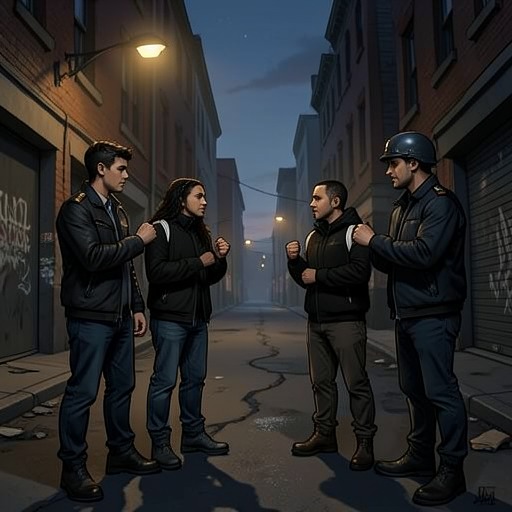
The Jets attack the Puerto Rican grocery store
West Side StoryThe Jets’ attack on the Puerto Rican grocery store is a small but revealing episode of territorial violence: after frightening a middle-aged couple back inside, the gang sends a stink bomb into the crowded shop and treats the humiliation as a lesson in who controls the street. The assault makes visible how hostility toward Puerto Ricans is enacted not only in gang confrontations, but also against residents who are simply trying to leave a neighborhood store.
Background: A City Looking for a Target
The episode unfolds in a city where gangs have turned a thousand streets and ten thousand homes, rooftops, basements, and alleys into a battleground. Puerto Ricans have become a convenient target: their arrival gives the gangs someone to blame, and some residents tell themselves that the city is safer for everyone else so long as the violence falls on them. The narrator exposes the cruelty of this bargain by showing how readily blame is assigned to people who have little power over the conditions around them.
That hostility sits within a crowded, deteriorating neighborhood where ordinary tenants have few affordable places to move. Residents who fear the Jets often avoid drawing attention to themselves; people at windows and on stoops look away or hide behind newspapers and handkerchiefs rather than invite trouble. Some even concede that the Jets are doing something to defend what remains of their neighborhood, in contrast to politicians who neither live there nor speak for its tenants. Such explanations help account for the gang’s local standing, but they do not excuse its attacks on Puerto Rican residents.
Riff’s thinking also casts the conflict as a contest over territory. He resents Tony’s absence and recalls that the Jets once fought to win and hold their block. In his view, Bernardo is gathering Puerto Ricans with the evident aim of taking control of the neighborhood, a fear Riff expresses through openly racist contempt. The grocery attack occurs within this climate of suspicion, in which a Puerto Rican presence is treated as a territorial threat even when the people encountered are not shown posing any danger.
The Attack on the Store
During the patrol, Action points out a Puerto Rican man and woman, both about fifty, as they emerge from a small Puerto Rican grocery. The couple sees the Jets, hesitates, exchanges a look, and retreats toward the shop. Their attempt to withdraw does not end the encounter. Riff gives the signal, and Snowboy, who likes to imagine himself as a commando, opens the door and throws a stink bomb into the crowded store.
After catching up with the others, Snowboy makes a contemptuous remark to Baby-John, comparing the Puerto Ricans to pigs and suggesting that the foul-smelling bomb should not bother them. His comment recasts an act of intimidation as a joke at the victims’ expense. The store’s crowded interior and the couple’s retreat make the attack more than a challenge between rival gang members: it carries the Jets’ hostility directly into a place where Puerto Rican residents are gathered.
Lessons and Escalation
Baby-John listens approvingly and stores the incident away for future use. He has already watched Riff and Action deal with motorists who act as though buying a car gives them ownership of the street; now Snowboy supplies another example of how the Jets can humiliate people they regard as outsiders. Baby-John imagines that the couple may tell their sons what happened and that those sons might retaliate. He dismisses the prospect as no problem, reasoning that any Puerto Rican who steps into Jet territory will face the gang.
The episode thus teaches the younger Jet not only a tactic but a rule of belonging: the gang claims the power to define its territory and to punish those it associates with the rival group. The couple’s possible response is already imagined as a future confrontation, so the attack points toward retaliation even before any counterattack occurs. The Jets then continue their patrol, belligerent and eager for a fight.
Later, when the Jets spot three Sharks across the street, the rivals flee into a building entrance, and Riff curses that there is no point pursuing them. Their escape redirects the gang’s attention toward finding the enemy elsewhere. The grocery assault belongs to this continuing patrol rather than standing as an isolated encounter: ordinary Puerto Rican residents are targeted along the way, while the Jets remain ready to turn the neighborhood into a direct confrontation with the Sharks.